EA License (CBDU596771)
 Written By
Banty S.
Written By
Banty S.
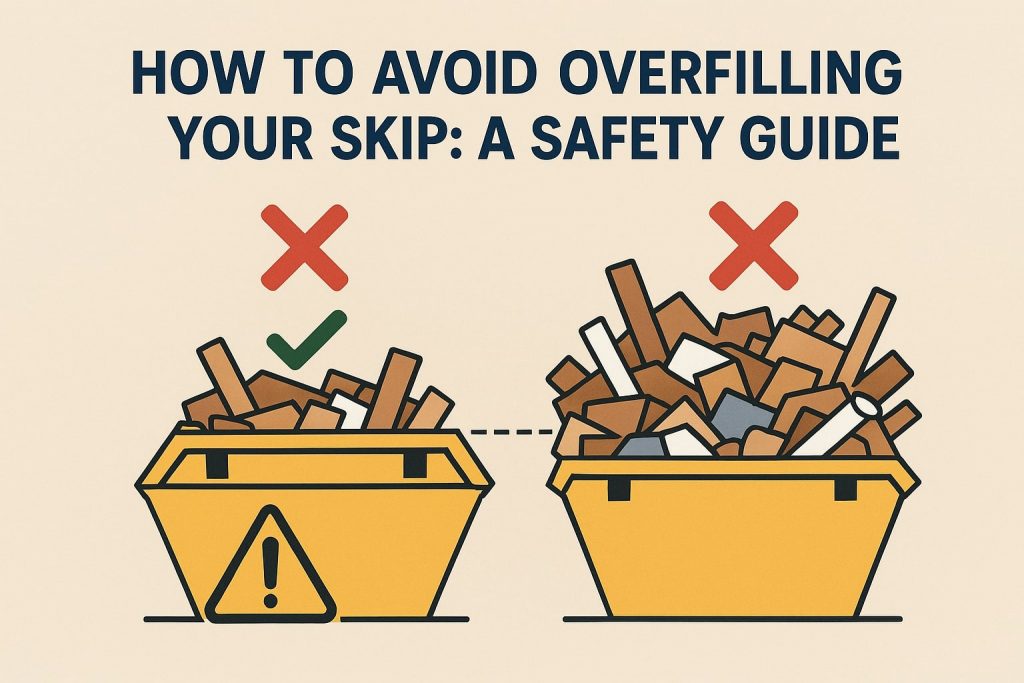
Keep all waste inside the skip and no higher than its sides. Bags mounded above the rim, protruding objects and uneven loads can prevent collection.
A skip can also be too heavy even when the waste is below the top. If the driver cannot collect it safely, the excess must be removed or rearranged before another visit.
The top edges of the container provide a clear limit. Skip Hire Team’s terms and conditions state that skips must not be filled over the edge.
This is a booking condition, not a separate HSE rule that makes the rim a statutory “fill line”.
UK road-transport rules more broadly require loads to be arranged and secured so they do not create a danger.
|
Load condition
|
Ready for collection?
|
What to do
|
|---|---|---|
|
Waste is contained and no higher than the sides
|
Usually, subject to weight and contents
|
Complete the final checks
|
|
Loose bags or waste are mounded above the rim
|
No
|
Remove the excess
|
|
Timber, doors or furniture stick out above the sides
|
No
|
Repack safely or remove them
|
|
Waste hangs over an edge
|
No
|
Remove it and clear the area around the skip
|
|
Dense waste is below the rim but may be too heavy
|
Need to confirm
|
Contact Skip Hire Team before collection
|
Covering the load does not make an overfilled skip acceptable. It must still meet the booking conditions.
An overfilled skip has too much waste by volume. An overweight skip contains more weight than the container or collection vehicle can safely handle. Soil, concrete, bricks and rubble are dense, so a skip below the rim can still be too heavy. A larger skip is not automatically suitable for these materials.
A level load may also be refused if it contains undeclared restricted waste. Check what can and can’t go in a skip and the skip weight and volume guide before loading heavy or uncertain material.
The driver assesses the load and access before collection. If the skip is overfilled, unstable, too heavy or otherwise unsafe, collection may not go ahead.
The usual next steps are:
Loose items left beside the skip are not included unless a separate service has been agreed.
Skip Hire Team’s current terms list a £85–£110 plus VAT wasted-journey charge where an overfilled skip cannot be collected.
This is a charge for the unsuccessful visit, not a government fine. Check the current terms because charges can change.
Stop adding waste and inspect the load from ground level.
Do not climb into the skip, stand on the waste or jump on it. Take care with sharp or unstable items and get help with anything too heavy or awkward to move safely.
For detailed packing advice, read how to fill a skip efficiently.
If you use a private waste collector in England, check the Environment Agency’s upper-tier waste-carrier register. Skip Hire Team does not provide man-and-van clearance.
See our skip hire versus man-and-van guide before choosing another provider. Never leave excess waste beside the skip expecting it to be collected.
Estimate the volume and type of waste before ordering. Sort it first, check the level as the skip fills and stop at the sides. Compare skip sizes or ask before booking if the job includes heavy or restricted waste.
If your Skip Hire Team container is safely loaded and ready to go, request a collection or exchange. If waste still remains, arrange the exchange before adding anything above the sides.
Planning a new job? Enter the delivery postcode to check the price for an available skip size.
The skip normally remains in place while you remove or rearrange the excess. Collection must then be rearranged, subject to availability, and Skip Hire Team’s current terms allow an £85–£110 plus VAT wasted-journey charge.
No. Overfilling concerns the volume and position of the waste. Overloading by weight happens when dense material makes the skip too heavy to lift or transport safely, even if the load is below the sides.
No. Boards or makeshift extensions do not increase the skip’s approved capacity. Keep the waste within the original sides of the container.
Keep it out of the skip. You can request an exchange, order another suitable skip, use a registered waste collector or take eligible household waste to an authorised recycling centre.